Some fires burn loud and fast, visible from miles away. The ones spreading across Indonesia right now do the opposite — smoldering silently beneath the surface, sometimes for months, largely invisible to the naked eye and difficult even for satellites to fully track.
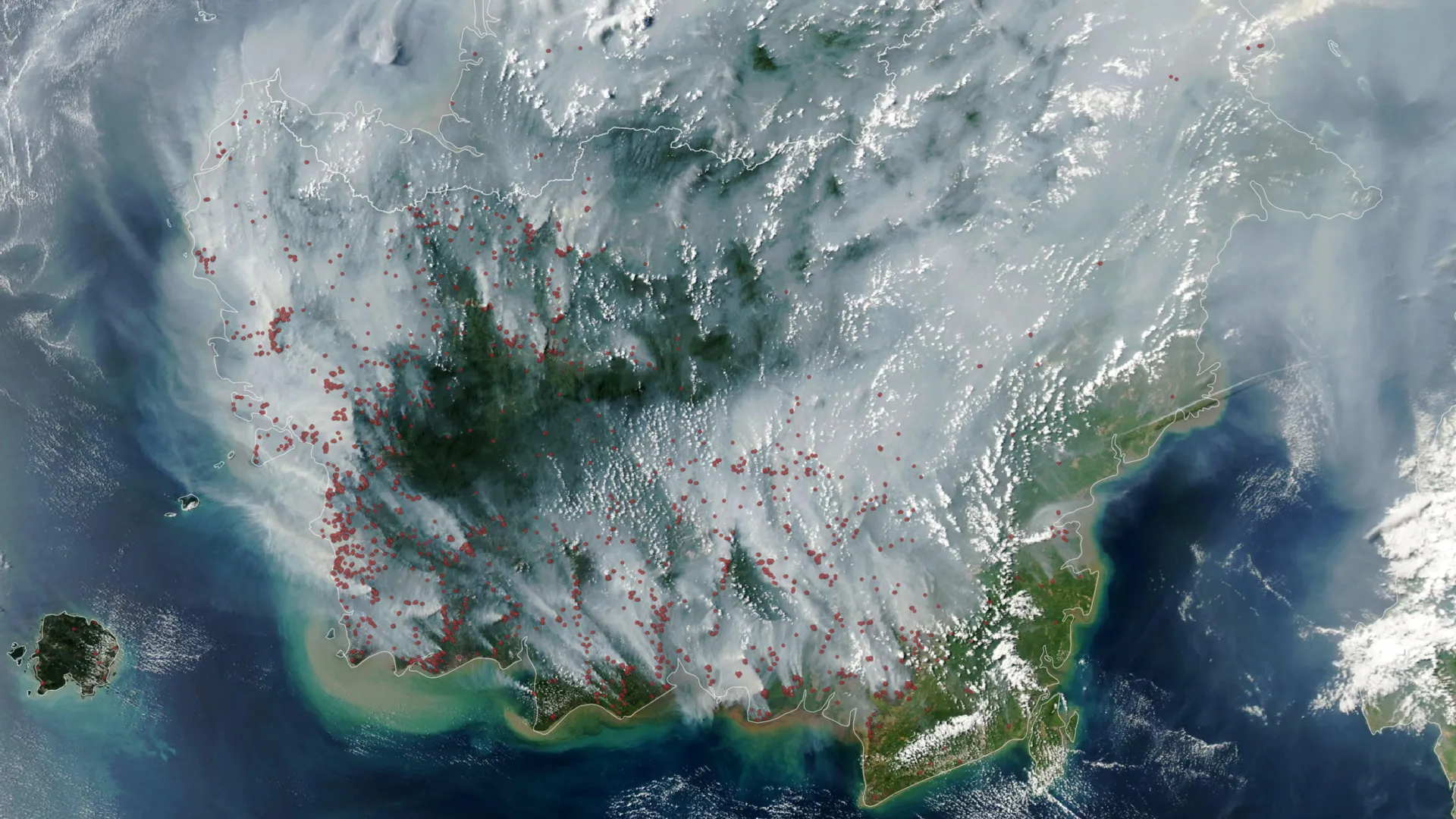
Indonesia's 2026 fire season is intensifying earlier and more aggressively than in most recent years, as a strengthening El Niño deepens drought conditions across the country's peat-rich regions, driving flames underground into carbon-dense soil that can smolder for extended periods. NASA's Aqua satellite captured imagery on September 1 showing widespread active fire detections across the archipelago, with Indonesia's Ministry of Forestry reporting 946 hotspots as of August 31 through its SiPongi fire-monitoring platform.
The scale of what's drying out is significant. Indonesia holds roughly 36% of the world's tropical peatlands, concentrated mainly across Sumatra, Kalimantan, and Papua. Peat itself — partially decomposed plant material accumulated over thousands of years in waterlogged conditions — normally stays too wet to burn easily. Under severe drought, though, that natural protection disappears entirely, turning what's usually a stable carbon reservoir into dangerously flammable fuel.
This year's conditions echo a pattern researchers have been watching closely: a strengthening El Niño, combined with a positive Indian Ocean Dipole, has left the region unusually dry. According to Indonesia's meteorological agency, roughly 90% of the country received little to no rainfall in early August — nearly identical to conditions recorded in 2015, widely regarded as one of Indonesia's most destructive modern fire seasons.
Robert Field, a researcher at Columbia University who studies fire weather, told NASA that fire activity has already been climbing sharply, showing genuine similarities to that earlier disaster year. "Surface fires are less of a concern," he noted, "but when fires get underground, they just won't stop."
The numbers so far offer some perspective, even if they're not yet reassuring. As of September 2, this year's fires — burning for about a month — had released roughly 10% as much greenhouse gas equivalent as the entire 2015 season eventually produced. That earlier season, after more than three months of burning, ultimately released an estimated 1.75 billion tons of greenhouse gas equivalents — more than Japan emits in a full year — with associated economic losses estimated at over $16.1 billion, according to PreventionWeb.
What makes peat fires uniquely harmful isn't just their persistence, either. Compared with a typical tropical forest fire, they release roughly three times the fine particulate matter, about five times the sulfur dioxide, and nearly double the methane and carbon monoxide — a genuinely dangerous combination for regional air quality that, in past severe seasons, has blanketed large areas in smoke for weeks and disrupted daily life for millions of people across Southeast Asia.
Nearly 6,000 firefighters have already been deployed to combat blazes in Jambi province alone, though officials cite deep peat soil, limited water access, difficult terrain, and strong winds as significant obstacles — even with helicopter support in the mix.
For a country that implemented substantial reforms following the catastrophic 2015 season, this year's early, aggressive fire activity is already raising a pointed question researchers and officials are watching closely: whether those post-2015 protective measures are proving equal to conditions that increasingly resemble the very disaster they were designed to prevent.
Spotted a story we should dig into? Drop us a line at tips@kanilprwire.com.