Google's newest climate deal is unusual in one specific way: the company won't actually receive any of the product it's paying for.
Google announced an agreement with Swedish company Stegra (formerly H2 Green Steel) to purchase environmental attribute certificates tied to near-zero-emissions steel from Stegra's massive new plant under construction in Boden, in northern Sweden, just south of the Arctic Circle. The deal, covering up to 91,000 metric tons of steel produced during the plant's first year of operation, marks the second such agreement Stegra has secured.
The mechanism itself is the interesting part. Google isn't buying any physical steel from the Boden facility — that metal will simply be sold into the standard European steel market without any special low-carbon labeling. Instead, Google is purchasing the environmental attributes associated with that steel separately, a system known as "book and claim." In practical terms, Google gets to count the emissions reduction associated with a ton of Stegra's near-zero-emissions steel toward its own sustainability targets, while Stegra receives crucial early revenue that helps offset the considerable extra cost of hydrogen-based steel production during its startup years.
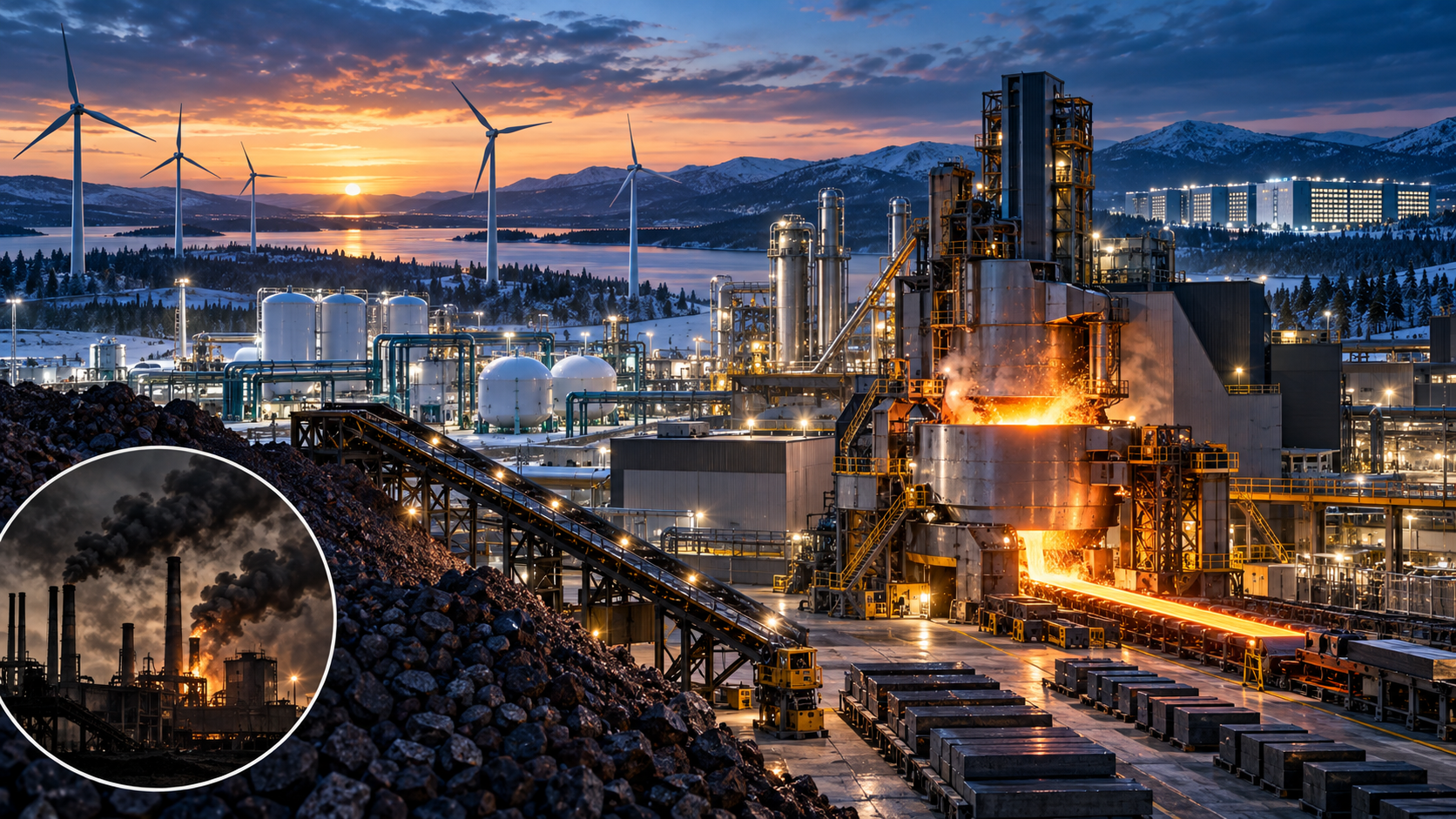
The environmental case for Stegra's process is significant. Traditional steelmaking relies on coal-fired blast furnaces to convert iron ore into usable iron — one of heavy industry's most stubbornly carbon-intensive processes. Stegra's approach instead uses renewable electricity to generate green hydrogen, which then reacts directly with iron ore to produce iron without coal in the equation at all. The company estimates this cuts emissions by up to 95% compared to conventional blast-furnace production, with output designed to meet the International Energy Agency's formal definition of near-zero-emissions steel.
For Google specifically, the deal connects directly to a genuine sustainability challenge the company disclosed recently: its annual emissions rose 18% between 2024 and 2025, driven largely by increased use of steel, concrete, and computing hardware for data center construction. Buying into cleaner steel production, even indirectly through certificates, gives Google a way to address that materials-driven emissions growth without needing Stegra's physical product to be geographically or logistically available at its specific data center sites.
Adam Elman, Google's Director of Sustainability for Europe, the Middle East, and Africa, framed the certificate model as one tool among several. "Decarbonizing the most challenging sectors requires every tool in our toolbox," he said. "Having proven this model with clean electricity and expanded it to other areas like sustainable aviation fuel, we see green steel EACs as another promising lever to address industrial emissions and scale the clean technologies of the future."
Stegra CEO Henrik Henriksson welcomed the partnership's timing specifically. "Google is naturally one such player" capable of moving markets toward decarbonized industrial products, he said, adding gratitude for the company's support "in this way" during Stegra's critical first years of operation.
Industry observers note the deal isn't without its limits. As one analysis pointed out, an environmental attribute certificate records verified environmental benefit, but doesn't eliminate delivery, verification, or accounting risk entirely — the next real milestones will be the plant's actual commissioning, independently measured emissions performance once operational, and confirmation that each certificate is uniquely and transparently assigned, avoiding any double-counting of climate benefit.
For an industrial sector long considered one of the hardest to decarbonize, deals like this represent an early, imperfect, but increasingly common financing bridge — letting major corporate buyers help fund genuinely difficult clean-technology transitions, even when they can't yet receive the physical product those transitions produce.
Know something we don't? Tip us at tips@kanilprwire.com.