NASA Reveals Close-Up Photos of the Crater a SpaceX Rocket Left on the Moon
NASA's Lunar Reconnaissance Orbiter captured detailed images of the crater left by a discarded SpaceX Falcon rocket stage, offering scientists rare real-world data on lunar surface impacts.
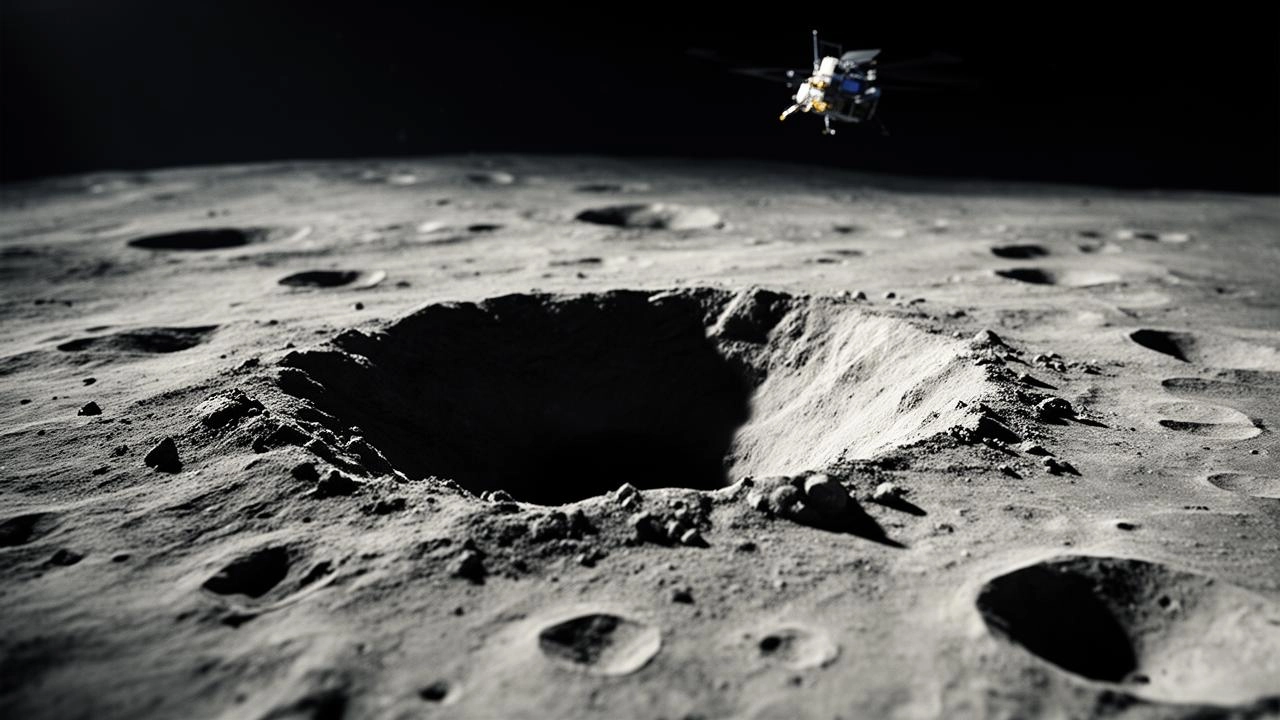
Image Credit: BigGo Finance
The Moon has a new scar, and NASA just got its clearest look at it yet.
Earlier this month, the spent upper stage of a SpaceX Falcon rocket slammed into the lunar surface near the Einstein crater, traveling at roughly 5,400 miles per hour — about 8,700 kilometers per hour. It wasn't planned as some dramatic event; the stage had simply been drifting through space, discarded and uncontrolled, for more than a year before gravity finally pulled it down.
This week, NASA released before-and-after images captured by its Lunar Reconnaissance Orbiter, giving scientists the sharpest view yet of what that impact actually did to the surface.
The numbers are almost deceptively modest. The crater measures around 60 feet across — about the length of a bowling lane — and less than 10 feet deep. But the real story isn't the size of the hole itself. It's what surrounds it: distinct streaks of displaced rock and lunar dirt radiating outward from the impact site, sometimes described as resembling butterfly wings spreading from the center.
Getting the shot wasn't as simple as just pointing a camera. The orbiter has been circling the Moon since 2009, completing a polar orbit roughly every two hours as the Moon rotates beneath it — meaning the crash site wasn't even in view when NASA started looking. Flight controllers had to tilt the spacecraft's cameras toward the impact zone and then wait nearly six days for the location to rotate back into position. The orbiter finally captured the images from about 60 miles up, moving at roughly one mile per second, on August 11 and 12.
NASA wasn't actually first to the scene. South Korea's Danuri spacecraft, operated by the Korea Aerospace Research Institute, beamed back the earliest photos of the crash site shortly after the impact happened.
None of this was exactly a surprise to NASA. The agency had been tracking the Falcon 9 upper stage using both ground-based telescopes and space assets in the lead-up to the crash, working alongside SpaceX to refine exactly where and when it would hit. Officials confirmed well ahead of time that the impact posed no risk to Earth, and scientists actually welcomed the opportunity — a controlled study of what happens when a roughly 8,800-pound piece of hardware slams into the lunar surface at high speed doubles as useful data.
That data matters more than it might seem at first glance. NASA is working toward establishing a permanent Moon base by 2032, and understanding impact dynamics, surface composition, and debris behavior all feed directly into planning for that future infrastructure. As one former NASA associate administrator put it, this was one small crash for SpaceX, but potentially a useful data point for lunar science going forward.
For now, professionals and hobbyist astronomers alike get to study genuinely fresh, real-world impact data — a rare chance to compare predictions against an actual, documented lunar collision rather than relying purely on models.