Tonight's Sky Show: A "Blood Moon" So Deep, It Won't Happen Again Until 2028
A deep partial lunar eclipse covering 96% of the Moon's surface unfolds overnight on August 27-28, visible across the Americas, Europe, and Africa — with astronomers calling it the best lunar eclipse until 2028.
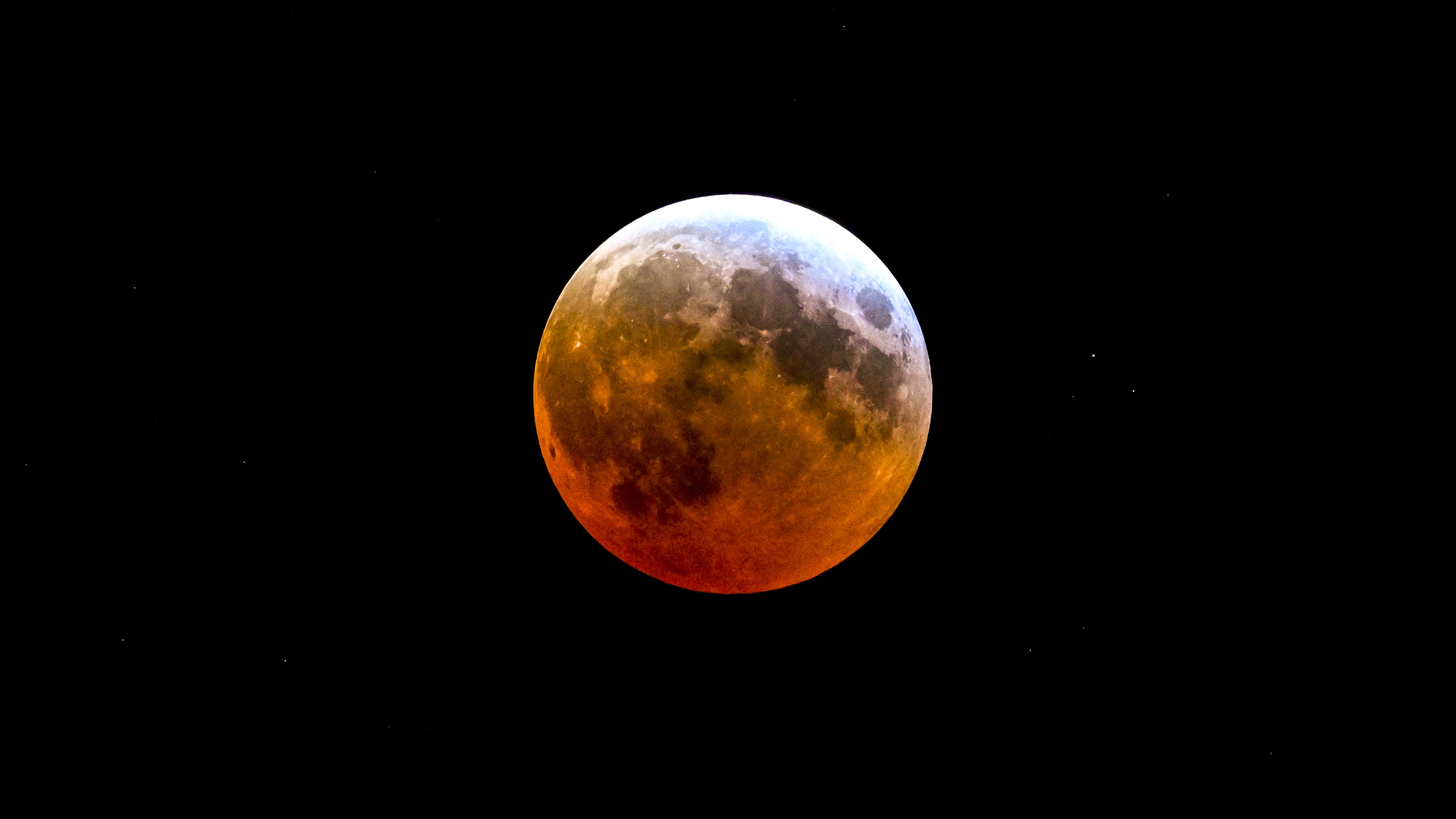
Image Source : Space
Look up tonight, and you might catch one of the best lunar eclipses this side of the decade.
A deep partial lunar eclipse unfolds across the night sky on August 27-28, with NASA confirming the Moon will slip into Earth's shadow, covering roughly 96.3% of its visible surface at maximum eclipse — close enough to a total eclipse that skywatchers should expect a striking, deep copper-orange glow across almost the entire lunar disk.
The timing breaks down like this: the partial phase begins around 9:34 p.m. CDT on August 27, with the eclipse reaching its dramatic peak — what astronomers call "maximum eclipse" — at 11:13 p.m. CDT that same night (12:12 a.m. EDT, or 4:12 a.m. UTC on August 28, depending on your time zone). From start to finish, the entire event stretches across roughly 5 hours and 39 minutes, though the visually striking partial phase itself lasts about 3 hours and 18 minutes.
Visibility spans a huge swath of the globe. North and South America get the fullest view of the event, while Europe and Africa will catch the eclipse as the Moon sits lower in the western sky, closer to moonset. Observers on the West Coast — in cities like Los Angeles and Portland — will see the deepest phase just after midnight local time; East Coast viewers in places like New York get a similarly well-timed peak around the same local hour.
Here's the good news for anyone without fancy equipment: unlike a solar eclipse, this one requires absolutely no special gear. No eclipse glasses, no filters, nothing. It's completely safe to watch with the naked eye, and binoculars or a small telescope will only sharpen the view of that deep reddish hue as Earth's shadow creeps across the lunar surface.
That reddish-orange coloring isn't just for dramatic effect — it happens because sunlight passing through Earth's atmosphere gets filtered and bent, scattering blue wavelengths away and letting longer, redder wavelengths reach the Moon's surface, the same basic physics behind a sunset. With 96% coverage, this eclipse comes about as close as physically possible to that full "blood moon" effect without technically crossing into total eclipse territory.
For context on just how rare tonight's viewing conditions are: astronomers are already calling this the best lunar eclipse visible until New Year's Eve 2028, when the next true total lunar eclipse — nicknamed the "New Year's Blood Moon" — is set to occur.
Cloud cover, as always, remains the one variable nobody can control. But for anyone with a clear sky and a few free hours tonight, this is a genuinely rare chance to watch the Moon put on one of its most dramatic shows in years — no equipment, no planning, no cost. Just look up.
Got a tip or breaking story for us? Reach out at tips@kanilprwire.com.
This article was written with the assistance of Artificial Intelligence (AI) tools. While our editorial team reviews all AI-assisted content for accuracy and quality, readers are advised to verify critical information from primary sources. The views and information presented are for informational purposes only.