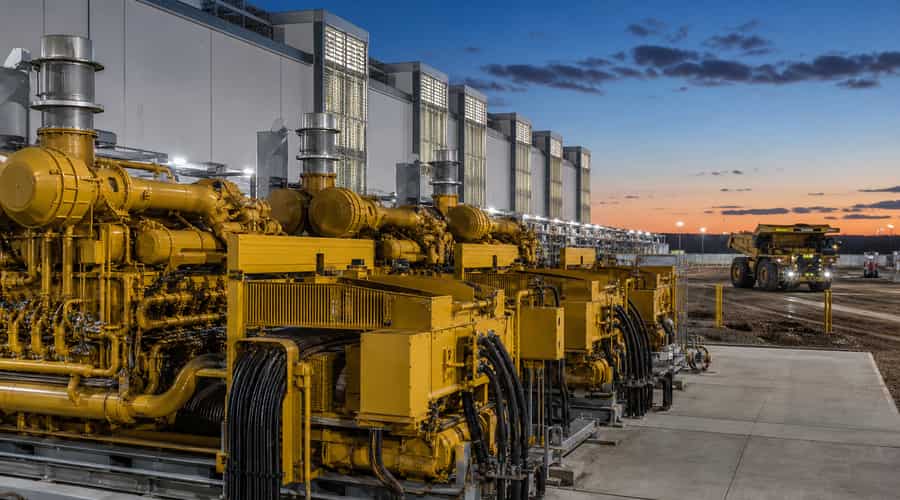
For most companies, rolling out AI means fine-tuning a chatbot. For Caterpillar, it means applying lessons learned from robots that have already moved 11 billion tons of rock without a single reported injury.
The heavy equipment giant is taking what it learned building autonomous mining trucks and applying it to a much broader AI push across the company, CTO Jaime Mineart told TechCrunch on the sidelines of the Ai4 conference in Las Vegas earlier this month. "Now we're in this super exciting time where we can take all of that learning from mining and bring it into much more dynamic environments, jobsites, quarries, and construction sites," she said.
The scale of that mining experience is genuinely enormous. Caterpillar currently operates roughly 690 autonomous mining trucks, which together have traveled more than 385 million kilometers and moved over 11 billion tons of material — more than double the total autonomous mileage of the entire automotive industry combined, according to Mineart's earlier CES 2026 remarks. The company says none of that autonomous operation has resulted in a single reported injury.
That track record is now informing how Caterpillar rolls out AI in far messier, less predictable environments than a mining pit. Unlike mining sites, which typically involve defined areas and repeatable routes, construction jobsites and quarries bring far more variable conditions — different terrain, changing tasks, and less predictable layouts. Mineart said the company is deliberately carrying over its mining playbook while adapting the underlying technology to handle that added complexity.
One concrete example already in customers' hands: the Cat AI Assistant, which lets field technicians use voice commands standing right next to a machine to pull up repair procedures and troubleshoot problems on the spot, without needing to dig through manuals or call for support.
Mineart was candid about where the real difficulty lies — and it's not the engineering. "The hard part about autonomy and about physical AI is incorporating that technology into the customer jobsite and into the workflows," she said. Deploying an autonomous machine, in other words, is a fundamentally different challenge than getting an entire worksite to actually operate around it. That means rethinking command structures, training programs, and how human operators and AI-driven machines coordinate day to day.
Caterpillar's approach leans heavily on institutional knowledge rather than starting from scratch. The company is training its AI systems using input from experienced operators who've spent decades learning the nuances of heavy equipment work — knowledge Mineart said is proving essential for teaching machines to handle the kind of judgment calls that don't show up cleanly in a training dataset.
The shift is also reshaping what jobs on these sites will look like. As machines become more autonomous, Mineart suggested some operators may transition from directly controlling a single piece of equipment to instead overseeing multiple machines simultaneously from a remote command center — a shift already underway in Caterpillar's mining operations that the company now expects to extend further.
The investment behind this push is substantial. Caterpillar has committed $100 million over the next five years specifically to train 118,000 employees in AI, autonomous technology, and robotics — a workforce bet that suggests the company sees this transition as a long-term structural shift, not a short-term pilot program.
Beyond the physical equipment itself, AI is also reaching into Caterpillar's software and manufacturing operations — powering digital twins for manufacturing sites, assisting with modernizing legacy code, and helping detect software defects earlier in development, according to Mineart. The company posted record quarterly revenue of $20.5 billion in its most recent quarter, giving it substantial resources to fund the broader transformation.
For an industry not typically associated with cutting-edge AI headlines, Caterpillar's approach offers a useful counterpoint to the software-first AI narrative dominating most tech coverage: sometimes the hardest — and most valuable — lessons about deploying AI at scale come from decades spent automating the physical world first.
Know something we don't? Tip us at tips@kanilprwire.com.