A Robot Just Beat Usain Bolt's Sprint Record — Then Face-Planted Into a Cushion to Stop
Chinese humanoid robots Tiangong Ultra and Lightning both broke Usain Bolt's 17-year-old 100m world record at the World Humanoid Robot Games in Beijing, though neither could stop without crashing into a padded barrier.
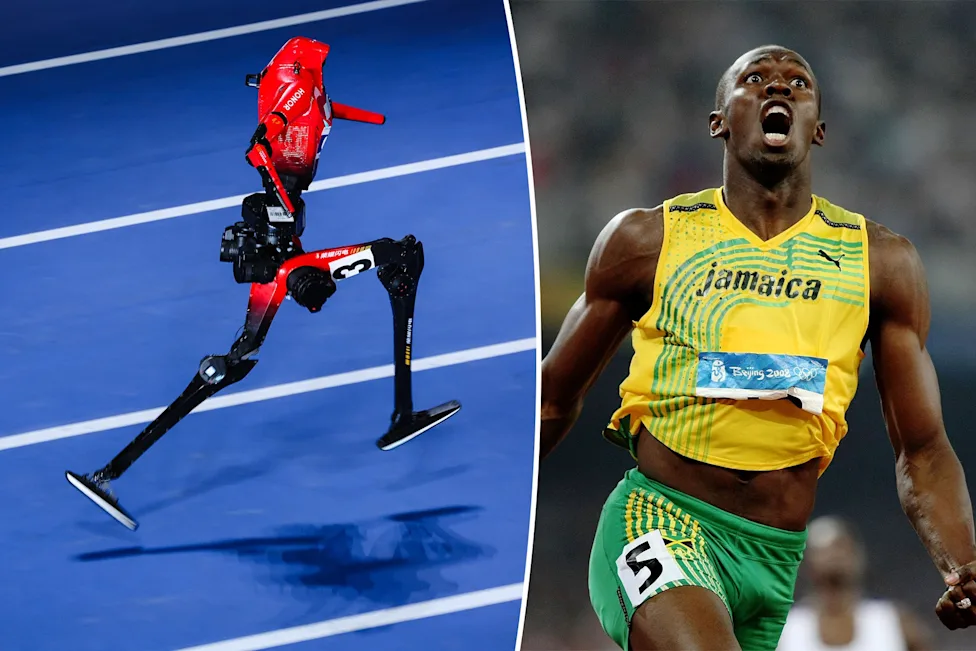
Image Credit : Yahoo Sports
For 17 years, Usain Bolt's 100-meter world record stood untouched by anything human. This weekend, something not-quite-human finally broke it.
At the opening ceremony of the World Humanoid Robot Games in Beijing on Saturday, a humanoid robot named Tiangong Ultra, developed by the Beijing Innovation Centre of Humanoid Robotics, completed a 100-meter sprint in 9.39 seconds — beating Bolt's legendary 9.58-second mark, set at the 2009 World Athletics Championships in Berlin. A second Chinese robot, Lightning, built by smartphone maker Honor, also crossed the human benchmark, clocking 9.47 seconds in the final after reportedly hitting 9.32 seconds during an earlier test run.
The numbers alone are striking, but the full picture is a bit messier — and more human than it sounds. Neither robot had a graceful way to actually stop. Footage from the event showed both machines slamming into padded cushions at the finish line before falling to the ground, after which handlers carried them off on stretchers, same as an injured athlete would be.
That combination — genuine mechanical breakthrough paired with very visible growing pains — defined much of the opening day. Lightning reportedly hit a peak speed of 14.5 meters per second during its record test run. Meanwhile, a separate robot from the same manufacturer behind Tiangong Ultra broke another human record entirely, clearing 2.88 meters in the standing high jump — well past the 2.45-meter mark set by Cuba's Javier Sotomayor back in 1993.
Not every robot on the track had a good day, though. Several competitors tripped, collapsed mid-stride, or broke apart entirely during their events. At least one reportedly caught fire.
The scale of the event itself is hard to overstate. More than 2,000 humanoid robots from 666 teams across 16 countries are competing across the five-day games, spanning 51 different events and over 1,300 individual competitions — everything from sprinting and high jump to table tennis and soccer. Organizers say the number of participating teams grew 138% compared to last year's inaugural edition, held at the same venue: the National Speed Skating Oval, originally built for the 2022 Winter Olympics.
The timing isn't accidental. China has designated humanoid robotics as a strategic technology priority, betting heavily that advances in AI and hardware engineering will accelerate real-world deployment across manufacturing, logistics, and eventually consumer applications. This weekend's games doubled as a very public showcase of that bet, running the same week Beijing hosted the 2026 World Robot Conference, where roughly 3,000 robotics products were on display.
There's also a broader technology competition simmering underneath the spectacle. The event follows recent moves by US regulators to restrict imports of foreign-made humanoid and quadruped robots over stated national security and cybersecurity concerns — a policy expected to particularly affect Chinese manufacturers, several of whom were front and center at Saturday's games.
Whether a robot that needs a padded cushion and a stretcher to stop counts as a genuine athletic milestone or an engineering curiosity is, fairly, up for debate. But the raw number — 9.39 seconds — now sits ahead of every human sprinter who has ever lived, at least on paper.
Got a tip or breaking story for us? Reach out at tips@kanilprwire.com.