Astronomers Just Found the Fastest Star in the Milky Way — And It Could Finally Reveal a Black Hole's Spin
A newly discovered star named S301 orbits Sagittarius A* faster and closer than any star ever observed, potentially giving astronomers their first direct measurement of a black hole's rotation.
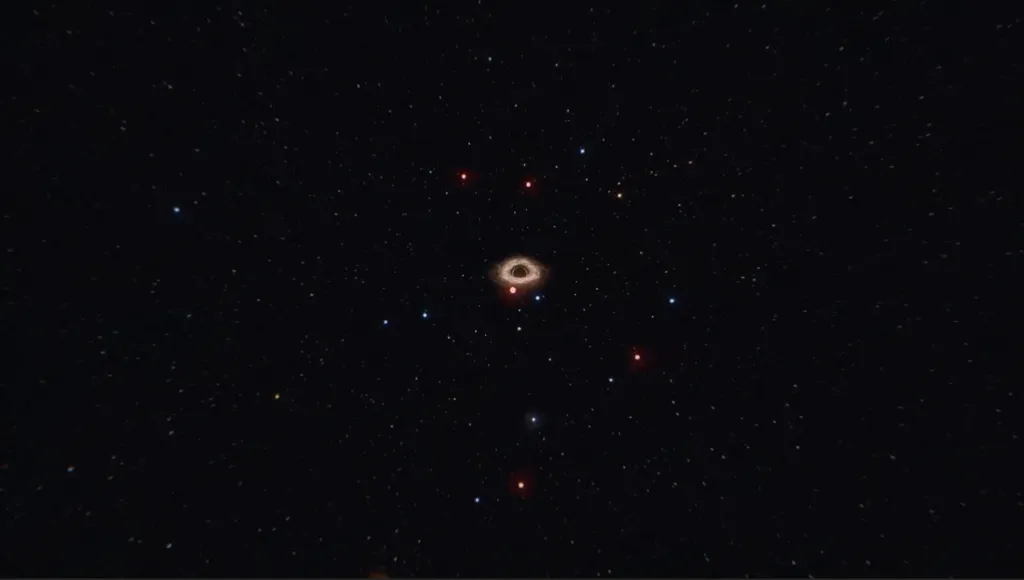
Image Credit : Science News
Somewhere near the center of our galaxy, a star is moving fast enough to cross the entire United States in about a sixth of a second.
Astronomers announced Wednesday that they've discovered the fastest star ever recorded in the Milky Way, a discovery detailed in a new paper published in Nature. The star, catalogued as S301, orbits Sagittarius A* — the supermassive black hole sitting at our galaxy's core — so closely and so fast that it might do something no star has ever done before: let scientists directly measure how quickly a black hole spins.
At its closest pass to the black hole, S301 hits roughly 25,000 kilometers per second, or about 15,500 miles per second. Put another way, it's moving at more than 8% the speed of light — fast enough that, in theory, you could travel from New York to Los Angeles in around one-sixth of a second, assuming you could survive the trip. No other star in the Milky Way has ever been clocked moving that fast.
Researchers at the European Southern Observatory spotted S301 using the Very Large Telescope Interferometer in Chile. What makes the star scientifically valuable isn't purely its speed, though — it's how close that speed brings it to Sagittarius A*. During its closest approach, S301 gets to within about 12 astronomical units of the black hole, a distance roughly comparable to how far Saturn sits from the Sun. That's closer than any star ever observed near a black hole of this kind.
Stefan Gillessen, one of the researchers involved, explained the real significance isn't the velocity record itself. It's what that proximity allows scientists to see — essentially using the star as a probe to watch how gravity bends space and time in one of the most extreme environments in the universe.
Here's where things get particularly interesting. Because S301 orbits so tightly, its path should get subtly bent by the black hole's own rotation, an effect predicted by Einstein's general relativity. If astronomers can track at least two full orbits of the star — each orbit takes roughly 8.7 years — they may be able to isolate that bending effect and, for the first time, directly calculate how fast Sagittarius A* itself is spinning. Scientists have long assumed the black hole rotates, based on theoretical models, but nobody has ever measured it directly.
There's a scientific catch, though. The region around the galactic center isn't exactly quiet. Surrounding stars, gas, and dark matter all generate their own gravitational tugs, which can distort an orbit in ways that mimic the relativistic effect scientists are actually hoping to isolate. Untangling the real signal from all that background noise will take careful modeling and, more than anything, patience.
Where did S301 even come from? Researchers at the Max Planck Institute for Extraterrestrial Physics believe it likely started as part of a binary star system. At some point, the black hole's tidal forces tore that pair apart — flinging S301 into its current tight orbit while its companion star was likely ejected entirely, possibly fast enough to leave the galaxy for good.
S301's next close pass to Sagittarius A* is expected in 2031. Astronomers plan to keep watching with the same VLTI instruments, and eventually with ESO's upcoming Extremely Large Telescope, hoping that a second full orbit gives them enough data to finally answer a question that's sat unresolved for decades: exactly how fast does the black hole at the center of our galaxy spin?
Got a tip or breaking story for us? Reach out at tips@kanilprwire.com.
This article was written with the assistance of Artificial Intelligence (AI) tools. While our editorial team reviews all AI-assisted content for accuracy and quality, readers are advised to verify critical information from primary sources. The views and information presented are for informational purposes only.